Introduction
As large language models increase the expected velocity of innovation, we're all working out how our roles could and are changing.
In design, a thousand think pieces have asked:
- is design over now that code is quick?
- does the design process only slow things down?
- is design still relevant as a “taste-maker”?
Though we can’t know better than anyone else how LLM technology will play out, we do think that design (with a lower case d) will continue to play a critical role in innovation, that there’s nothing inherent about moving slowly in design, and that Design (capital D) has become overly dependent on process to achieve quality.
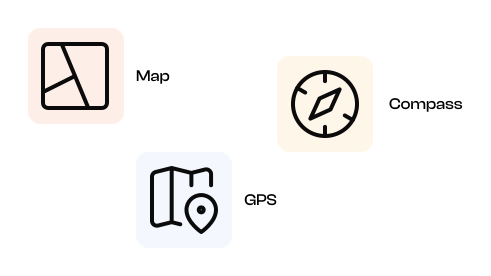
We will explore how the metaphors of Map, GPS and Compass have helped us think through these issues. We'll also introduce a model (called the IO Loop) that is helping us understand innovation in an age of hyper-velocity by thinking about change in 'states' that can shift rapidly, iteratively and non-linearly instead than 'stages' that proceed sequentially and conclusively.
Fair warning - this post will get abstract - if that's not for you, we entirely understand and suggest you skip this one or jump straight to the model.
Let's start by exploring how we think design adds value to innovation efforts, and how those activities came to be seen as "the design process".
Living between worlds
Design, by it’s very nature participates in two very different paradigms or 'states' within innovation:
- the possible (characterised by ambiguity, uncertainty and opportunity)
- the definitive (exemplified by clarity, certainty and tangibility).
Design is very comfortable with the early stages of change and inventing ideas where none existed before. It's also heavily involved, in often very different ways, in delivering on the subset of those ideas that are prioritised for execution.
With this liminal perspective comes a practiced fluency at navigating the tensions within, and between, these states. Design, whether practiced by a capital-D Designer or anyone working out a different possible state for the future, makes it’s contribution to innovation by acting as a bridge between ideas and reality, and helping others to manage that transition.
This liminality has been a source of constant tension for design, and many designers are familiar with the frustration of feeling they have to justify their contribution even as it’s clear on the ground that they’re making a significant one.
Mapping the process
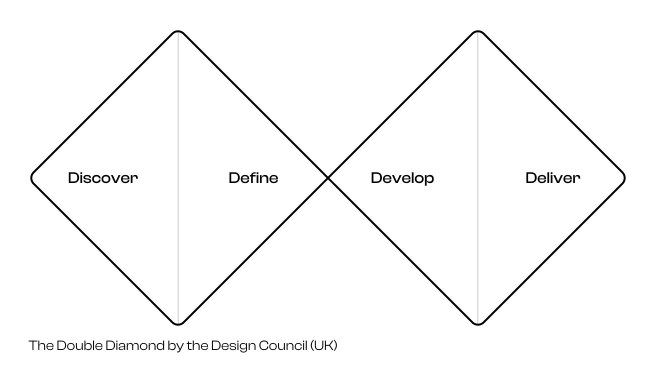
With such an intrinsic challenge to overcome, it’s not surprising that design has often turned to process to make it’s value concrete and understandable.
The Double Diamond, developed by the UK Design Council, is probably the most widely known example of this move.
Broad and shared awareness of practices promised to explain how projects shift from the possible to the definite, and explain the role of design along the way. Designers learned to use process to advocate for methods of navigating ambiguity (such as research or prototyping) that weren’t self-evident to collaborators anchored on the reality side of the ledger.
In doing so, designers imagined they were creating a Map of the domain, showing the challenges lying between one world and the next, and helping everyone cross over safely.
Experienced practitioners, recognising that the map is not the territory, used process as an orientation tool without surrendering their own judgement of when and how to use it.
Outsourcing directions to a GPS
This helped for a time, but the theory had an embedded flaw that surfaced when design practices scaled up through “design thinking” and the hyper-growth of big tech and product management. Process does provide a map of the terrain, but it has a second feature. It has directions built in, and as we outsource decisions to built-in directions, we lose the ability to leverage critical judgement and adapt dynamically to emerging challenges.
Adherence to "the process" came to be depended on as the indicator of quality, instead of the outcomes themselves. Critical practices of evaluation and adaptation are harder to implement when process becomes bureaucratic. Too often, the goal becomes to follow directions, rather than find the way.
Teams learnt to outsource critical thinking to the process, just as following a GPS blindly can direct drivers to dead-ends.
No plan survives contact with reality
This isn’t a new dilemma by any means. There’s a long lineage of thinking on the relationship between plans and reality:
- Paraphrasing the Prussian military commander Von Moltke , “no plan survives contact with the enemy”.
- John Boyd’s OODA loop proposed that increasing the velocity of sense-making to action provides strategic advantage, an idea that has had significant influence in the agile community.
- The Buddhist Heart Sutra points to a circular relationship between possibility and form.
- Thinking on Complexity emphasises emergence as a core principle of understanding reality.
These ideas share an insight into the dynamic nature of the relationship between what we want (our Intent) and the real world impact of our attempts to achieve it (Outcomes).
Reframing FROM to BETWEEN
If the Map failed us by becoming a faulty GPS, how do we resolve the issue so we can navigate the uncertainty of our current moment?
As we’ve explored these dilemmas, we’ve reframed our thinking in ways we’ve found helpful and developed an approach that we call the IO or Intent to Outcomes Loop. We’re definitely not making any grand claims to have discovered universal principles, however we’re finding this approach useful and it may spark something for others too.
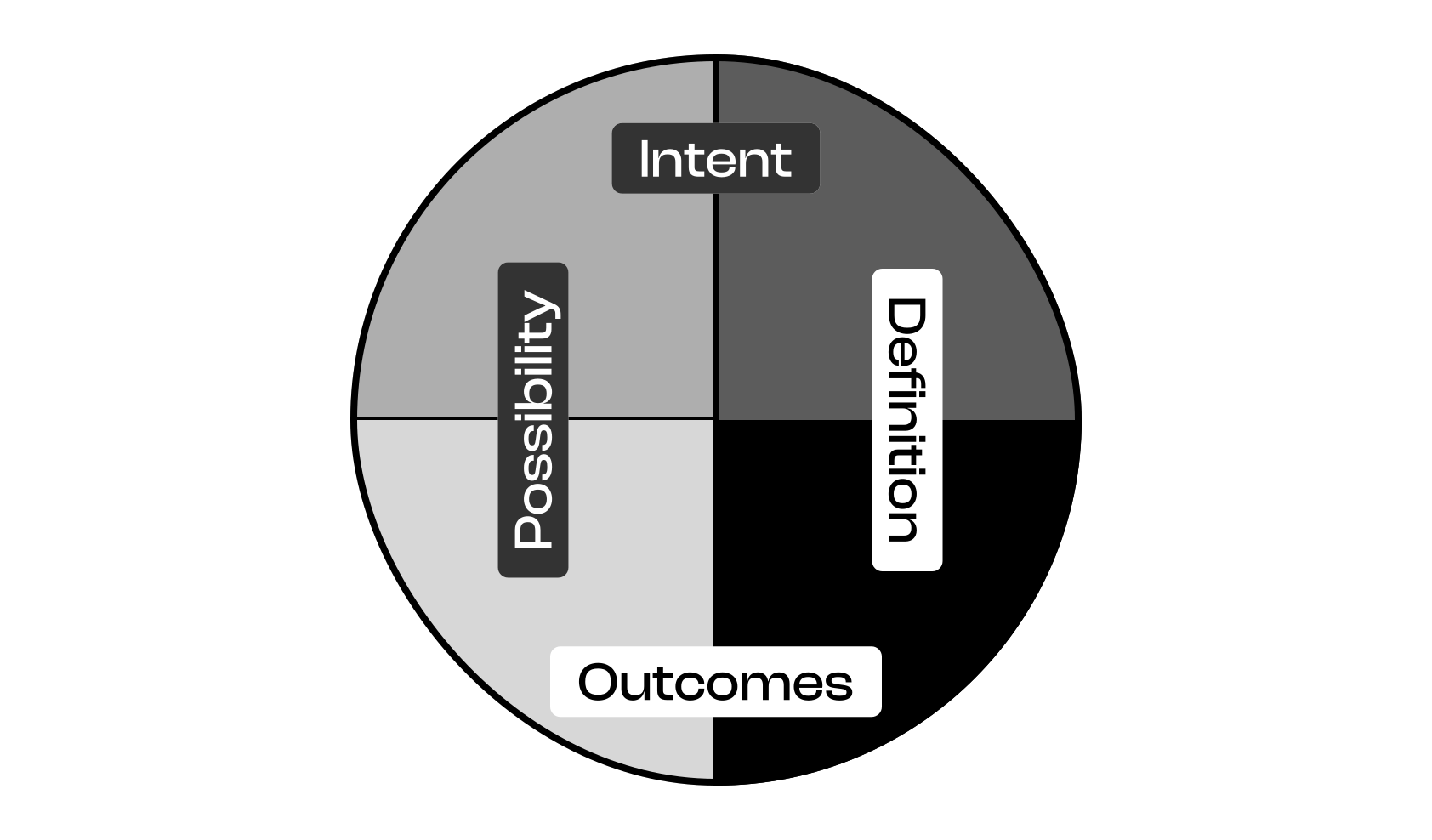
The core of our perspective is a shift from seeing design as a linear process that moves us FROM idea to execution, to looking at design as an evolving and recursive loop BETWEEN states:
- Outcomes (how it is)
- Intent (how we want it to be).
To get between them, we must pass through liminal states:
- Possibilities (how it could be)-
- Definition (what we can achieve).
Crucially, states and loops are more natural explanations for phenomena that are iterative, emergent and recursive:
- Each loop feeds the next cycle
- Large loops can contain smaller loops
We don't make any assumptions about the size or shape of an object moving through the loop. It can describe the transition of a fleeting thought to a spoken word as well as between the movement from deep research to the delivery of a major project.
Where process created a GPS telling us to blindly follow directions, this re-framing returns us to a Map that creates shared understanding of the territory, without dictating the route.
You need a Compass to use a Map
So far so good, we’ve re-framed the Map from "stages" to "states", unfolding in "loops" instead of "lines".
To arrive at our final model, we add a layer of abstracted Actions over the map. These look the most familiar to the old frame of process, but sufficiently abstracted so they apply to many types of work. We think of them as suggestions for the mode of transport best suited to the terrain.
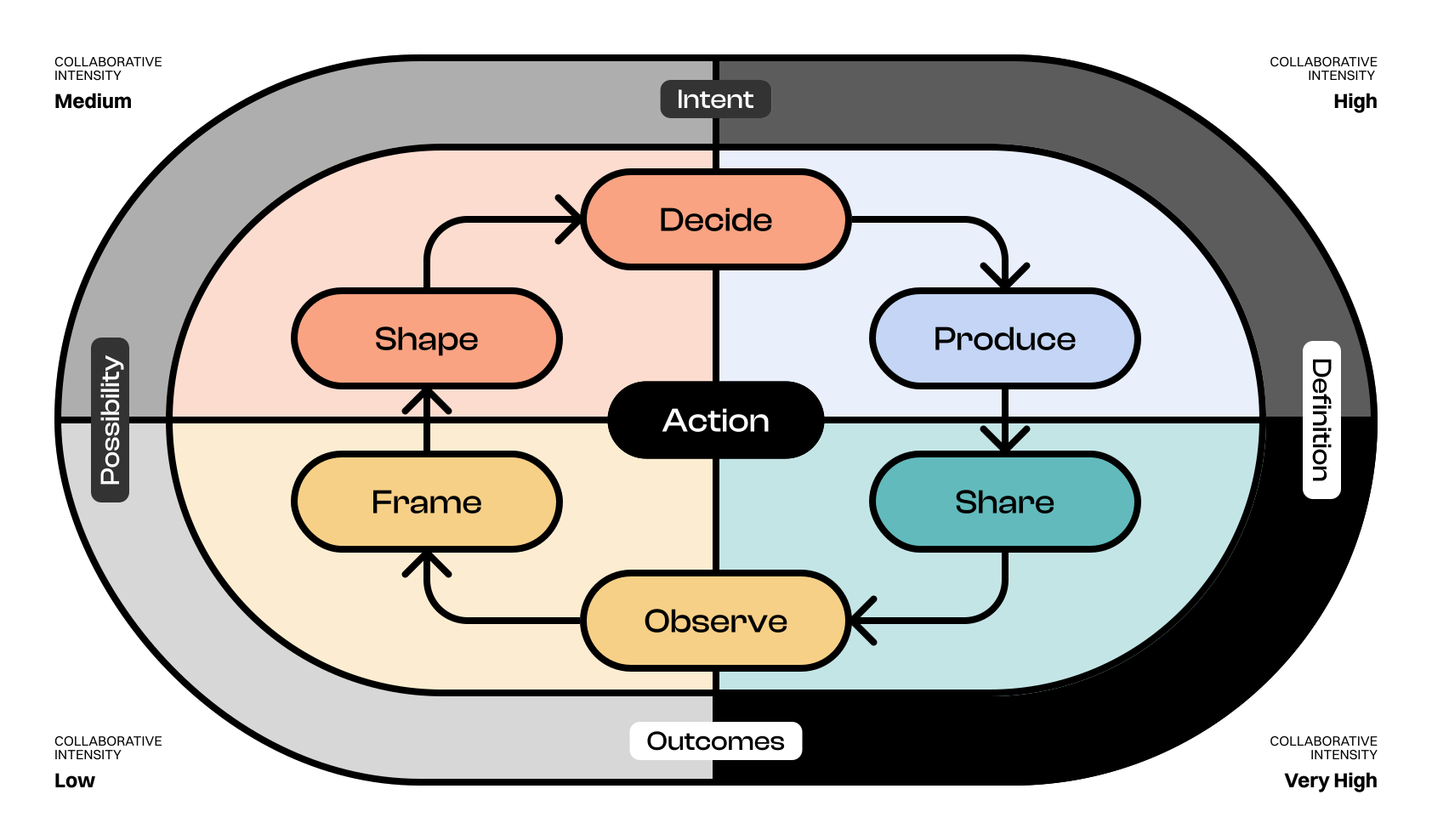
We explore the Action layer of the model further here. In this post though, we want to conclude by returning to the role of design.
There’s a missing piece that is vital to the effective use of a Map. Navigation with a Map only works if you have a Compass, pointing to True North.
That Compass is you, the designer and your ability to evaluate where the work is, and where it needs to go.
The conversation currently unfolding about taste and judgement comes tantalisingly close to capturing this but misses the mark somewhat by skimming the surface. Evaluation is more all encompassing. It asks “is it good?”, rather than “does it look good”.
Alongside evaluation (where are we now), the other role of a Compass is adaptation (where is True North?). Designers need to use their judgement and define the next point of call on the Map. That could be back or sideways as well as forward. This is the critical piece missing from a linear, process-centric approach. If best next step isn’t the next stage in the process, you should change the plan rather than continuing forward.
Without a Compass performing the critical role of evaluation and adaptation, and we’re left with a GPS that knows how to direct, but not to change course.
Conclusion
We've covered a fair amount of ground, so let's close with a recap.
Design anchored itself to process as a way of demonstrating value and co-ordinating activity across "stages", but increasingly struggled with dependency. We labelled this the GPS approach.
Instead we proposed turning to a Map of innovation "states", emphasising the idea of a Compass (the designer) who actively uses the Map to navigate using evaluation and adaptation. We shared our model (called the IO Loop) and our re-framing of design from a linear journey to a loop between states.
For us, an abstracted model is important because it allow us to use the same Map & Compass for radically different types and paces of work. It doesn’t matter whether you sketch in code or on paper, as long as you know whether you have passed the threshold of Possibility to Intent. The loops may be quicker but the challenges are the same. This is helping us maintain our orientation and stay focused on fundamentals as the pace of change accelerates.
We hope the thinking and the model we’ve shared help you find some orientation too. Please reach out and let us know if we’ve managed to help a fellow traveller.